

Mindfulness for Life
An eight week MBCT course
For anyone carrying more than they would like. Stress, low mood, anxiety, a busy mind that will not quieten. Eight weeks of structured practice, with a teacher, in a small group.
This course will not solve the things making life difficult. What it offers is a different relationship with them: the ability to notice what is happening in your mind and body before it has already carried you somewhere you did not want to go.
Mindfulness-Based Cognitive Therapy is recommended by NICE and supported by decades of research. The course draws on that lineage and is delivered in plain language, in a small group of up to 16, weekly via Zoom.
You do not need any experience of mindfulness. You do not need to be in crisis. You need to be curious, willing to practise at home between sessions, and ready to give eight weeks of Tuesday evenings to something that might actually help.
The price is £100 for the full eight weeks, around £11 per session. It is priced that way deliberately. This course should be accessible to anyone who needs it.
Ask your GP or contact us directly.
You do not need to be
at rock bottom to benefit.
- Carrying persistent low mood, anxiety, or stress that does not seem to shift
- Feeling reactive, on edge, or like the mind is running away with itself
- Moving through life on autopilot and wanting to feel more present
- Recovering from a difficult period and looking for tools to stay steadier
- Curious about mindfulness and ready to do more than read about it
- Referred by a GP, therapist, or other healthcare professional
- Eight weekly Tuesday evenings, 6.30pm to 8.45pm via Zoom
- One five-hour day of practice, usually at a weekend after session five. The date is confirmed at the start of the course.
- Daily home practice of up to 45 minutes between sessions
- Willingness to engage honestly with what comes up, without needing to share it with the group
- No prior experience of mindfulness is needed
Eight weeks.
One session at a time.
Each week builds on the last. By week five or six most people find themselves reaching for the practices without being prompted. That is when you know it is working.
Practice
The day of practice
The group meets once for a five-hour session of sustained practice, usually at a weekend after session five. Longer periods of sitting, walking, and body scan meditation, mostly in silence. It is the session most participants say they did not expect to value and ended up valuing most. Delivered online via Zoom, with the date agreed with the group at the start of the course.
A group, a teacher,
and a lot of practice.
Recommended by NICE.
Supported by decades of research.
Mindfulness-Based Cognitive Therapy is recommended by the National Institute for Health and Care Excellence for the prevention of depressive relapse. It has an extensive evidence base for stress reduction, improved attentional control, and emotional regulation across a wide range of populations.
A recent study published in The Lancet Psychiatry found MBCT to be as effective as antidepressants for people with difficult-to-treat depression. It is one of the most researched psychological interventions available.
GP and NHS referrals are welcome. Funded places are available via some local wellbeing teams and GP surgeries. Contact us or ask your healthcare provider for more information.
In their own words
November cohort.
Sixteen spaces.
The November cohort starts on Tuesday 3rd November 2026 and runs for eight consecutive Tuesday evenings, 6.30pm to 8.45pm via Zoom. The day of practice usually falls at a weekend after session five, and the date is agreed with the group at the start of the course.
Booking is via Stripe. Once you have booked you will receive a confirmation email with the Zoom link and information about what to expect in the first session. You do not need to do anything to prepare. Just turn up.
If you have questions before booking, or would like to speak to James before committing, email james@witteringwellbeing.co.uk and he will get back to you.
NHS and funded places. If you have been referred by your GP or a healthcare professional, or if the cost is a barrier, get in touch. Funded places are available through some local wellbeing teams and GP surgeries. We do not want cost to be the reason someone does not do this course.
Tuesday 3rd November 2026
Questions first? Email james@witteringwellbeing.co.uk
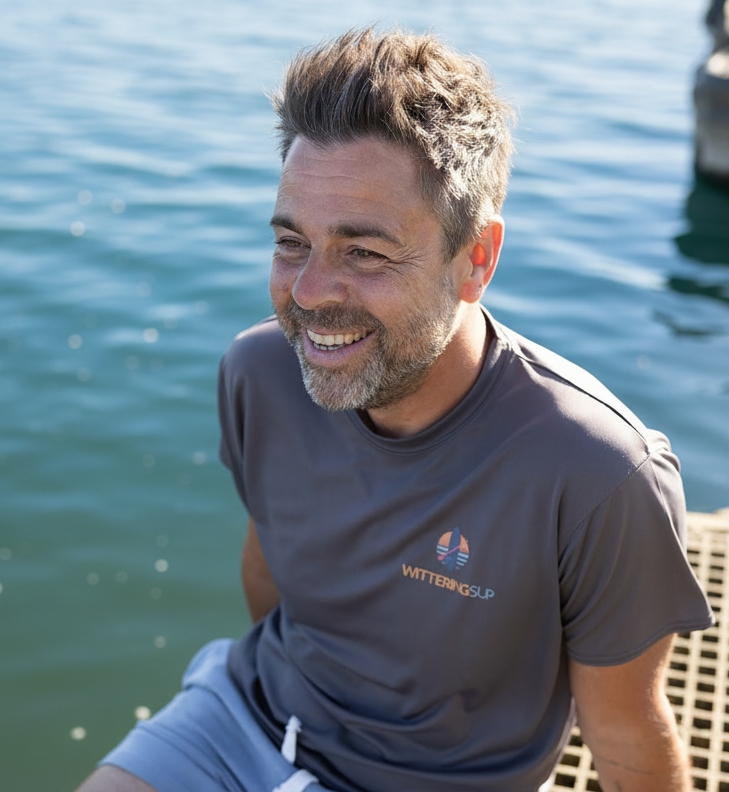
James is a qualified MBCT teacher trained through the Oxford Mindfulness Foundation. He has been delivering the Mindfulness for Life programme since 2021 and has worked with individuals across a wide range of backgrounds, including self-referrals, NHS referrals, and employer-funded participants.
He is also the founder of Wittering SUP, a paddleboarding school on the River Avon in Worcestershire with over 620 five-star reviews. His background in blue health, mindfulness, and time on the water shapes how he teaches: practical, patient, and grounded in the body as much as the mind.
He does not ask people to believe in anything. Only to notice what is already happening, and to practise until they can do that reliably.